The Painted Reptile
Ornate Box Turtle – Quick Care OverviewOrnate Box Turtle Care Sheet – Full DetailsThe Painted Reptile · Reptile supplies, care & advice
18730 Oxnard St., Unit 215, Tarzana, CA 91356
818-654-9441 · paintedreptile.com
Painted Reptile Care Sheet

Ornate Box Turtle

Terrapene ornata(Agassiz, 1857)

Also called: Western box turtle, plains box turtle; desert box turtle (traditionally T. o. luteola)

Group Turtle · Box turtleFamily EmydidaeWild status Near Threatened (IUCN)
Last reviewed November 2026
Photo coming soon

Quick facts

PR Keeper Level · care difficulty
6/10Intermediate
1 · Hardy & forgiving10 · Experts only
1–2 Very easy · 3–4 Beginner · 5–6 Intermediate · 7–8 Advanced · 9–10 Expert
PR Handler Level · temperament
Green – Calm & easygoing
Gentle and rarely bites, but shuts up in its shell and dislikes lifting — handle low and briefly
Green: Calm & easygoing Yellow: Squirmy or flighty Red: Known to be aggressive
Adult size
4–6 in. carapace
Lifespan
Decades (possibly much longer)
Temperature
Basking 90–95°F
Cool zone 70–77°F · nights can drop
Humidity
Adults 30–60% · hatchlings 60–70%
More arid than an eastern box, but still a humid hide
Diet
Omnivore
Varied animal and plant foods; not a dry pellet-only diet
Enclosure
4×2×1½ ft min. indoor (one adult)
Outdoor pen preferred in a suitable climate
Active
Diurnal
Temperament
Shy, terrestrial, better left to forage than carried around

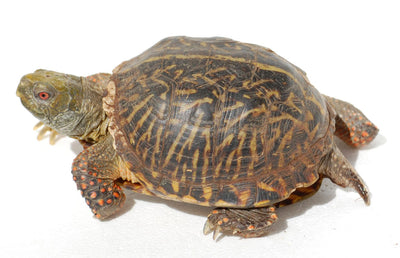
A small, domed grassland box turtle, distinct from the eastern and three-toed box turtles already on the site. It wants floor space, UVB, a humid hide even though it is a bit more arid than an eastern box, and a varied omnivore diet. This is a decades-long animal. Captive-bred only, and never sold with a shell under 4 inches.

Key care at a glance

  • HousingFor one adult indoors, at least a 4×2 ft floor (ReptiFiles; height about 18 in. so heat and UVB can be installed safely). One turtle is the simplest setup. A predator-proof outdoor pen with sun, shade, and a burrow is ideal in a suitable climate.
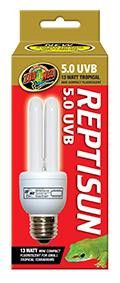
  • Heat & lightBasking 90–95°F, cool zone 70–77°F (ReptiFiles). Indoor heat off at night if the room stays reasonable. Quality UVB — a Zoo Med T5/compact 5.0 is the store-linked option — plus bright daytime light, with shade available. A splash-proof halogen is linked for basking.
  • HumidityAdults about 30–60%; hatchlings 60–70% (ReptiFiles). Always a humid hide with damp substrate on the cool end. A shallow water dish the turtle can enter and leave easily.
  • DietOmnivore. A mix of animal foods (worms, snails, appropriately sized insects, occasional moistened turtle diet) and plant foods (greens, flowers, limited fruit). Variety matters; vitamin A deficiency is a classic box-turtle problem.
  • HandlingBrief and low. They close the shell when unhappy. Support the body; never drop or flip for fun.
  • LegalCITES II, IUCN Near Threatened, and the federal 4-inch rule. Captive-bred paperwork.

Quick setup checklist

  • 4×2 ft or larger indoor floor for one adult, or a safe outdoor pen
  • Basking 90–95°F, cool 70–77°F, measured
  • Zoo Med 5.0-style UVB plus bright light and a shaded retreat
  • Humid hide, even though adults like moderate humidity
  • Shallow water the turtle can leave easily
  • Varied omnivore diet, not pellets alone
  • Captive-bred paperwork; no pet sales under 4 in. carapace (21 CFR 1240.62)
Want every detail? Natural history, breeding, health and more are in the full care sheet. Open full details

Supporting Sources: Reptile Database — Terrapene ornata · ReptiFiles — Ornate box turtle care · Species+ — CITES II · IUCN / GBIF — Near Threatened · 21 CFR 1240.62 · 14 CCR §671 · Existing site sheets · full list in Full details · full list on the full care sheet

The Painted Reptile · 18730 Oxnard St., Unit 215, Tarzana, CA 91356 · 818-654-9441 This care sheet is a general guide. Every animal is an individual, so watch yours closely and see a reptile veterinarian with any health concerns.
1

About the species

Species background & natural history

Named as Cistudo ornata by Agassiz in 1857; now Terrapene ornata. Two traditional subspecies appear in the trade: the ornate or plains box turtle (T. o. ornata) and the desert box turtle (T. o. luteola).

The Reptile Database, following TTWG 2025, currently does not recognize subspecies, while many keepers and field guides still use luteola for the western desert form. This sheet covers T. ornata as a whole and is not a separate ‘desert box turtle’ care sheet.

It is not T. carolina or T. triunguis (already sheeted). Hybridization with three-toed box turtles has been reported in Texas (Lutterschmidt et al. 2007, cited by the Reptile Database).

Physical description

A terrestrial box turtle with a high, hinged plastron that can close the shell. ReptiFiles: 4–6 inches (10–15 cm) long.

The carapace is typically dark with radiating yellow lines — the ‘ornate’ pattern. Males often have a more concave plastron and reddish eyes; those clues are not perfect.

This is a walking, digging grassland turtle, not a swimmer.

Distribution

A Great Plains and nearby species: the Reptile Database lists Wisconsin, Illinois, western Indiana, Iowa, southern South Dakota, southeastern Wyoming, Nebraska, Kansas, Oklahoma, southwestern Louisiana, Missouri, Arkansas, Texas, New Mexico, and southeastern Arizona, plus parts of Mexico (including Sonora, Chihuahua, and a Chiapas record). Type locality was later restricted in the literature (Iowa).

It is not a California native.

Lifespan

Box turtles are long-lived. ReptiFiles says that with excellent care a pet may live ‘possibly up to 100 years.’ Treat that as a possible upper end, not a typical promise; decades is a fair working expectation, in line with the eastern and three-toed sheets.

This is not a short-term pet.

2

Housing

Caging

  • ReptiFiles indoor minimum for one adult is a 4×2 ft footprint (120×60 cm): they raise the height recommendation to about 18 in. so heat and UVB can be provided safely.
  • An opaque 4–5 in. front barrier can reduce pacing.
  • One turtle per enclosure is simplest: they are not a social species.
  • Outdoor pens, where climate allows, should have sun: and shade all day, well-drained soil, walls at least 2 ft tall and smooth, sunk about 12 in. to block digging out, mesh on top against predators, and corner caps.
  • If night temperatures fall below 50°F, ReptiFiles says: a shelter with lightless heat (ceramic heater or radiant panel) set around 60°F is needed, and turtles should come indoors if winter temperatures go below about 25°F unless a proper, researched brumation plan is in place.
  • This sheet is not a brumation manual.

Cage decor & substrate

  • Deep, diggable, slightly moist substrate (soil mixed with coco: fiber or similar), leaf litter, a humid hide on the cool end, a shallow water dish or pan the turtle can enter and exit, and plants or cork for cover.
  • Keep the water shallow and easy to leave.
  • No steep drops.
  • A Zoo Med turtle dock is in the catalog but is more of an aquatic-turtle product: a shallow pan on the floor is the better water source for this terrestrial species.
3

Heat, light & humidity

Temperature needs

  • ReptiFiles indoor targets: basking area 90–95°F (32–35°C), cool zone 70–77°F (21–25°C).
  • Turn indoor heat off at night to allow: a drop, as long as the room is not frigid.
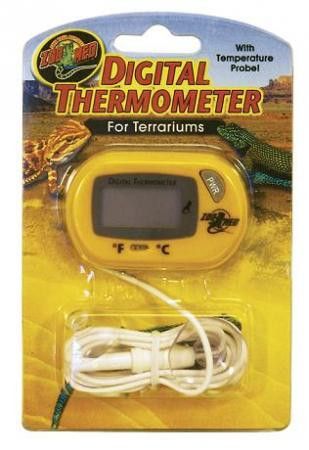
  • Measure basking and cool-end surfaces with a probe and an infrared thermometer.
  • Use a ceramic heater only to keep a shelter: from going too cold, not to run the whole pen at basking temperature overnight.

Heating & lighting

  • Diurnal.
  • ReptiFiles recommends a T5 HO 5.0-style UVB (they: name Zoo Med T5 HO ReptiSun 5.0 or Arcadia 6%) in a reflective fixture, plus a bright 6500K LED spanning most of the enclosure, and 50 W halogen floods (one for a juvenile, at least two for an adult) for an even basking area.
  • The store-linked options are Zoo Med 5.0 UVB: the Zoo Med T5 hood, the Zoo Med Repti Basking Bulb, and the Zoo Med Repti Tuff splash-proof halogen.
  • A tropical UVB-and-heat combo kit is also in the catalog.
  • Give shade so the turtle can leave the basking zone.
  • Aim, if you can measure it, for a basking: UVI around 3.0–4.0 (ReptiFiles).

Humidity & water

  • More arid than an eastern box, but not dry-desert: adults 30–60% average, hatchlings 60–70% (ReptiFiles), plus a humid hide with moist substrate at the cool end.
  • Morning misting of the substrate helps.
  • A shallow water dish at all times, cleaned often.
  • Hatchlings need the higher humidity and will fail: sheds if kept like a uro.
4

Feeding & supplements

Diet & feeding

  • Omnivore.
  • Offer a rotation of animal items (earthworms, snails: crickets, roaches, and similar) and plant items (dark leafy greens, edible flowers, squash, and only limited fruit).
  • A high-quality moistened turtle diet can be part: of the mix, not the only food.
  • Variety and a sensible calcium plan prevent the vitamin: A and shell problems this group is known for.
  • Do not use a cat-food staple.

Supplements

  • Lightly dust animal foods with calcium.
  • With UVB, calcium without D3 most of the time and a multivitamin less often is the usual pattern: if UVB is ever skipped (it should not be), D3 becomes important — but UVB plus diet is the plan here.
  • The catalog also has a Zoo Med Dr.
  • Turtle calcium block, which is an optional water: additive, not a substitute for UVB and a varied diet.
5

Breeding & handling

Breeding

Oviparous. Outdoor enclosures in the native range may lead to nesting.

This sheet is not a breeding or brumation manual. Do not collect wild adults or nests.

Handling your new pet

  • Brief, low, two-handed support.
  • They withdraw into the shell when stressed.
  • Wash hands after handling: turtles can carry Salmonella, which is the reason for the federal 4-inch rule.
6

Health & setup

Common health issues

  • Common husbandry problems in box turtles include swollen: eyes and ear abscesses (often linked to vitamin A and damp/dirty conditions), respiratory illness, pyramiding or soft shell, and retained sheds.
  • A reptile veterinarian who sees turtles should examine: new animals and any turtle with closed eyes, bubbles from the nose, or a soft shell.
  • Indoor turtles still need UVB.

Quick setup checklist

  • 4×2 ft or larger indoor floor for one adult, or a safe outdoor pen
  • Basking 90–95°F, cool 70–77°F, measured
  • Zoo Med 5.0-style UVB plus bright light and a shaded retreat
  • Humid hide, even though adults like moderate humidity
  • Shallow water the turtle can leave easily
  • Varied omnivore diet, not pellets alone
  • Captive-bred paperwork; no pet sales under 4 in. carapace (21 CFR 1240.62)

Shop the setup

Supporting Sources

The Painted Reptile · 18730 Oxnard St., Unit 215, Tarzana, CA 91356 · 818-654-9441 This care sheet is a general guide. Every animal is an individual, so watch yours closely and see a reptile veterinarian with any health concerns.
Just added to your wishlist:
My Wishlist
You've just added this product to the cart:
Go to cart page