The Painted Reptile
Mali Uromastyx – Quick Care OverviewMali Uromastyx Care Sheet – Full DetailsThe Painted Reptile · Reptile supplies, care & advice
18730 Oxnard St., Unit 215, Tarzana, CA 91356
818-654-9441 · paintedreptile.com
Painted Reptile Care Sheet

Mali Uromastyx

Uromastyx disparHeyden, 1827

Also called: Mali spiny-tailed lizard, Sudan mastigure (species-level English name on the Reptile Database)

Group Lizard · AgamidFamily AgamidaeWild status Least Concern (IUCN)
Last reviewed November 2026
Photo coming soon

Quick facts

PR Keeper Level · care difficulty
5/10Intermediate
1 · Hardy & forgiving10 · Experts only
1–2 Very easy · 3–4 Beginner · 5–6 Intermediate · 7–8 Advanced · 9–10 Expert
PR Handler Level · temperament
Yellow – Squirmy or flighty
Young uros are skittish and may tail-whip or bite; most tame with patient hand-feeding
Green: Calm & easygoing Yellow: Squirmy or flighty Red: Known to be aggressive
Adult size
11–15 in. total
Lifespan
15–25+ yrs
Temperature
Basking 120–130°F
Cool zone ~85°F · some keepers run a warmer mid-floor
Humidity
20–30%
Dry air · humid burrow below a dry surface
Diet
Herbivore
Greens, flowers, seeds — not a bug-eater as an adult
Enclosure
4×2×2 ft minimum
Deep diggable sandy substrate · one lizard
Active
Diurnal
Temperament
Alert, can tame with patient feeding

The common pet-trade ‘Mali uromastyx’ is usually Uromastyx dispar maliensis, a mid-sized spiny-tailed lizard that needs serious heat, strong UVB, and a dry, plant-based diet. Daily care matches the Saharan and ornate uromastyx already on the site; this sheet is for U. dispar, not those species.

Key care at a glance

  • HousingA 4×2×2 ft (120×60×60 cm) enclosure or larger for one adult, front-opening, with excellent ventilation and a secure lid. Deep sandy substrate they can burrow in. One lizard per enclosure.
  • Heat & lightBasking surface 120–130°F (ReptiFiles, genus-level). Cool zone around 85°F. Bright 6500K daytime light plus a strong Zoo Med 10.0 T5 UVB over the basking end, with shade at the cool end. All heat on a thermostat or dimmer.
  • HumidityAbout 20–30% ambient (ReptiFiles; Reptiles Magazine wants under 30%). The top of the substrate stays dry; a deeper burrow can be slightly more humid.
  • DietHerbivore. A daily salad of mixed greens and endive, plus flowers and seeds as appropriate. Adults are not an insect species. Dust lightly with a calcium/mineral supplement.
  • WaterThey get most moisture from food. A standing water bowl is optional and, in humid rooms, can work against you. Offer occasional shallow water if the diet is dry.

Quick setup checklist

  • 4×2×2 ft or larger, well-ventilated, one adult
  • Basking surface 120–130°F, cool zone ~85°F, measured with an infrared thermometer
  • Strong Zoo Med 10.0 UVB plus bright daytime light, with shade at the cool end
  • Deep sandy substrate, dry on top, with a burrow or cool hide
  • Daily greens-based salad; not an insect diet
  • Ambient humidity about 20–30%
  • Captive-bred paperwork (CITES II genus)
Want every detail? Natural history, breeding, health and more are in the full care sheet. Open full details

Supporting Sources: Reptile Database — Uromastyx dispar · Reptiles Magazine — Mali Uromastyx Breeding · ReptiFiles — Uromastyx care · Species+ — Uromastyx dispar, CITES II since 4 Feb 1977 · IUCN / GBIF — Least Concern · 14 CCR §671 · Existing site sheets · full list in Full details · full list on the full care sheet

The Painted Reptile · 18730 Oxnard St., Unit 215, Tarzana, CA 91356 · 818-654-9441 This care sheet is a general guide. Every animal is an individual, so watch yours closely and see a reptile veterinarian with any health concerns.
1

About the species

Species background & natural history

Uromastyx dispar was named by Heyden in 1827. The usual US pet-trade animal is the subspecies U. d. maliensis (Joger & Lambert, 1996), from northwestern Mali and adjacent southwestern Algeria.

It is a different species from the ornate uromastyx (U. ornata) and the Saharan uromastyx (U. geyri) already sheeted. The Reptile Database notes that U. d. maliensis has been kept with U. acanthinura and U. geyri for years without interbreeding (Joger & Gray, 1997).

Physical description

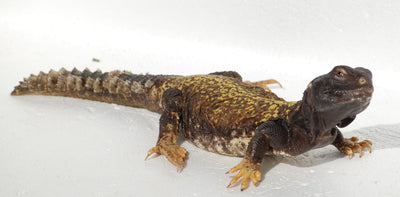
A medium spiny-tailed lizard. Reptiles Magazine: adults 11–15 inches total and about 7–14 ounces.

The tail is ringed with spiny scales and is used in defense. Color is often yellow, tan, or orange with darker markings; males are usually brighter.

This is not the much larger Egyptian uromastyx.

Distribution

The species as a whole is a Sahel and Saharan animal: U. d. dispar in Mauritania, Sudan, Chad (Tibesti and Ennedi), and (fide moroccoherps.com) Morocco; flavifasciata in Western Sahara, Mauritania, and southwestern Algeria; hodhensis in Mauritania; maliensis in northwestern Mali and southwestern Algeria (Reptile Database). Type locality of the species: the desert near Ambukol and Dongola, Sudan.

Lifespan

Aligned with the existing Saharan and ornate sheets: 15–25+ years with good care. ReptiFiles (genus-level) says they can live over 25 years and ‘quite possibly up to 60.’ The 60-year figure is possible but not used as the typical number here.

2

Housing

Caging

  • Reptiles Magazine’s Mali article uses at least 48×24×14 in.
  • The existing Saharan and ornate sheets, and this: draft, use a 4×2×2 ft minimum so there is room for a deep burrow, a Retes-style basking stack, and safe UVB distances.
  • Front-opening, very well ventilated, one lizard.
  • Do not use loose, collapse-prone ‘cave’ substrate piles without a proper structure.

Cage decor & substrate

  • A basking platform or rock stack under the heat: and UVB, a cool hide or burrow, and 4 inches or more of packed fine sand or sandy soil (ReptiFiles).
  • The top inch should stay dry.
  • Avoid dusty calcium sand and dusty wood bedding.
  • A hide at the cool end large enough: for the lizard to turn around (Reptiles Magazine describes low, wide ceramic or rock hides).
3

Heat, light & humidity

Temperature needs

  • Primary target follows ReptiFiles (genus-level) and the existing uro sheets: basking surface 120–130°F, cool zone about 85°F.
  • Reptiles Magazine’s Mali article is different: basking 115°F ±5, mid-floor 95–100°F, and a cool hide of 90°F ±5 — a hotter cool end.
  • This draft stays with the ReptiFiles / existing-sheet: figures and flags the Magazine’s warmer cool end as a disagreement for the owner.
  • Measure basking with an infrared thermometer.
  • Night drops are normal when the room is not cold: use a thermostat-controlled ceramic heater only if the room falls too low.

Heating & lighting

  • Diurnal and a true sun-lover.
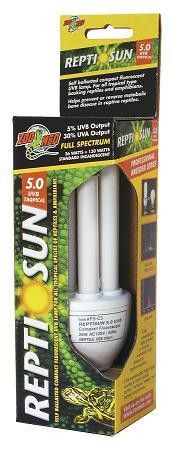
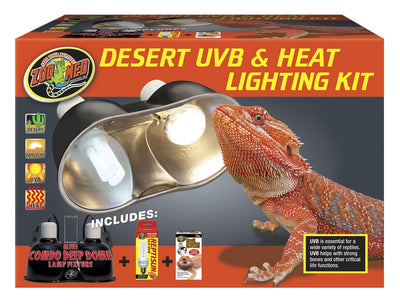
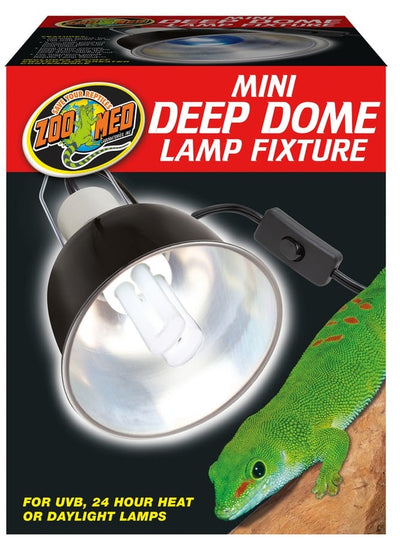
  • Provide (1) a Zoo Med basking bulb in a ceramic-socket: dome over the basking area, and (2) a Zoo Med ReptiSun 10.0 T5 HO UVB, about half the enclosure length, on the warm side, in a reflective hood.
  • ReptiFiles aims for a basking UVI around 4.5–6.0: when it can be measured.
  • Add bright 6500K visible light.
  • Do not use a heat rock.
  • A mercury-vapor or PowerSun bulb can combine heat and UVB if distance and temperature are measured carefully: separate lamps are easier to control.

Humidity & water

  • Ambient 20–30% (ReptiFiles) or below 30% (Reptiles Magazine).
  • High humidity plus cool temperatures is a common: way these lizards get sick.
  • A humid burrow under a dry surface is useful.
  • Reptiles Magazine says a standing water bowl is not required and can be detrimental indoors: they get moisture from salad.
  • Occasional shallow water is fine if the diet is dry.
  • Do not soak the whole cage.
4

Feeding & supplements

Diet & feeding

  • Herbivore as an adult.
  • Reptiles Magazine’s base mix is a 50/50 blend: of spring greens and chopped endive, misted with water, once a day, plus a light daily mineral dust.
  • Add other dark leafy greens, edible flowers, and modest: amounts of seed or lentil as variety.
  • Avoid spinach, high-oxalate staples, and fruit-heavy mixes.
  • Insects are not a staple for adults (juveniles in some collections take a little: keep the diet plant-based unless you have a species-specific reason).

Supplements

  • Light daily or near-daily calcium/mineral dust on the salad: (Reptiles Magazine uses a low-D3 mineral).
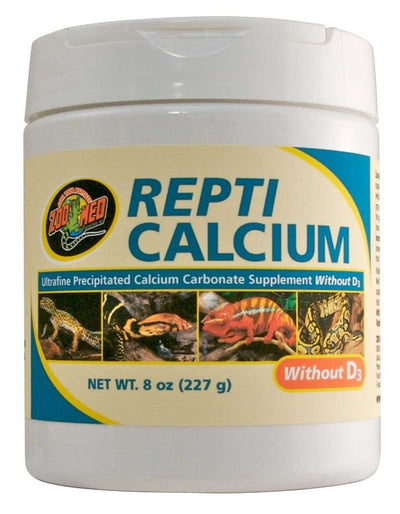
  • Because strong UVB is required, a calcium without: D3 plus a modest multivitamin is the usual combination.
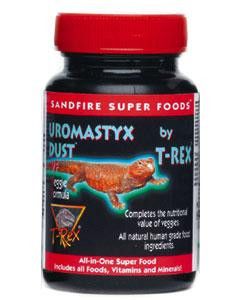
  • T-Rex Uromastyx Dust is in the store catalog: (currently out of stock) and is linked as a species-specific option.
5

Breeding & handling

Breeding

Oviparous. Reptiles Magazine: animals generally need to be longer than 10 inches and over about 5¼ ounces before breeding successfully; they describe a cool-end nest box and 60–80 day incubation.

A winter cooling period is used by many breeders. This sheet is not a breeding manual.

Handling your new pet

  • Support the body and avoid the tail as a handle.
  • Young animals may whip the tail or bite.
  • Many calm down when they learn that a hand means salad.
  • Handle low and briefly.
6

Health & setup

Common health issues

  • The usual problems are metabolic bone disease (weak: UVB or poor calcium), overheating, respiratory or skin issues from chronic damp, and obesity.
  • Watch the tail base and jaw for softness: and the weight of the body over the legs.
  • New animals should be checked by a reptile veterinarian.

Quick setup checklist

  • 4×2×2 ft or larger, well-ventilated, one adult
  • Basking surface 120–130°F, cool zone ~85°F, measured with an infrared thermometer
  • Strong Zoo Med 10.0 UVB plus bright daytime light, with shade at the cool end
  • Deep sandy substrate, dry on top, with a burrow or cool hide
  • Daily greens-based salad; not an insect diet
  • Ambient humidity about 20–30%
  • Captive-bred paperwork (CITES II genus)

Shop the setup

Supporting Sources

The Painted Reptile · 18730 Oxnard St., Unit 215, Tarzana, CA 91356 · 818-654-9441 This care sheet is a general guide. Every animal is an individual, so watch yours closely and see a reptile veterinarian with any health concerns.
Just added to your wishlist:
My Wishlist
You've just added this product to the cart:
Go to cart page