The Painted Reptile
Florida Kingsnake – Quick Care OverviewFlorida Kingsnake Care Sheet – Full DetailsThe Painted Reptile · Reptile supplies, care & advice
18730 Oxnard St., Unit 215, Tarzana, CA 91356
818-654-9441 · paintedreptile.com
Painted Reptile Care Sheet

Florida Kingsnake

Lampropeltis floridanaBlanchard, 1919

Also called: Brooks’ kingsnake (historical trade name)

Group Snake · ColubridFamily ColubridaeWild status Not separately assessed (IUCN); L. getula is Least Concern
Last reviewed November 2026
Photo coming soon

Quick facts

PR Keeper Level · care difficulty
2/10Very easy
1 · Hardy & forgiving10 · Experts only
1–2 Very easy · 3–4 Beginner · 5–6 Intermediate · 7–8 Advanced · 9–10 Expert
PR Handler Level · temperament
Green – Calm & easygoing
Usually tolerant once settled; strong feeding response — use tongs and wash off rodent scent
Green: Calm & easygoing Yellow: Squirmy or flighty Red: Known to be aggressive
Adult size
About 3–4 ft typical · rarely to ~5¾ ft
Lifespan
20+ yrs
Temperature
Basking 85–90°F
Cool side 70–78°F · night drop is fine
Humidity
40–60%
Humid hide when shedding · do not keep the cage wet
Diet
Carnivore
Frozen/thawed rodents (tongs only)
Enclosure
48×24×24 in. (adult)
Secure, locking lid · one snake
Active
Often crepuscular; may be out day or dusk
Temperament
Active, hardy, usually handleable

A light, speckled kingsnake from southern Florida, kept much like the other kingsnakes already on the site. Give it a 4×2×2 enclosure, a warm hide, a humid hide, and tongs-fed frozen/thawed rodents, and house it alone.

Key care at a glance

  • Housing48×24×24 in. or larger for one adult, locking lid, one snake only (kingsnakes eat other snakes).
  • Heat & lightBasking surface 85–90°F, cool side 70–78°F. Optional Zoo Med 5.0 UVB on the warm side is beneficial.
  • HumidityAbout 40–60%, with a damp-moss hide at shed time. This is a more mesic (less bone-dry) form than the desert kingsnake, but the cage still should not stay wet.
  • DietFrozen/thawed rodents, tongs only. In the wild they also eat other snakes, lizards, turtles and eggs — never house this species with another reptile.
  • HandlingUsually fine once settled. Wash off rodent scent; use tongs at feeding time.

Quick setup checklist

  • 48×24×24 in. or larger, locking lid, one snake only
  • Warm hide, cool hide, and a humid moss hide
  • Basking 85–90°F, cool side 70–78°F, measured
  • Clean water bowl and 40–60% average humidity
  • Frozen/thawed rodents, tongs only, not overfed
  • Optional but useful Zoo Med 5.0 UVB
Want every detail? Natural history, breeding, health and more are in the full care sheet. Open full details

Supporting Sources: Reptile Database — Lampropeltis floridana · Florida Museum of Natural History — Florida Snake ID Guide · ReptiFiles — Kingsnake care · GBIF — L. floridana as a synonym of L. getula · 14 CCR §671 · Existing site kingsnake sheets · full list in Full details · full list on the full care sheet

The Painted Reptile · 18730 Oxnard St., Unit 215, Tarzana, CA 91356 · 818-654-9441 This care sheet is a general guide. Every animal is an individual, so watch yours closely and see a reptile veterinarian with any health concerns.
1

About the species

Species background & natural history

Described by Blanchard in 1919 as Lampropeltis getula floridana. The Reptile Database, following Krysko et al. (2017), now treats it as the full species L. floridana.

GBIF still treats the name as a synonym of L. getula — a live taxonomy disagreement, noted below. Historical trade names include Brooks’ kingsnake (L. getula brooksi).

It intergrades with L. getula over much of Florida (Reptile Database). It is a different species (or, on the GBIF view, a different form) from the California, Mexican black, and desert kingsnakes already sheeted or in this batch.

Physical description

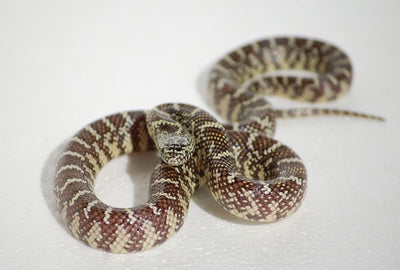
The Florida Museum of Natural History: most adults are about 36–48 inches (90–122 cm), with a recorded maximum of 69.4 inches (176.3 cm). Pattern is typically a light brown or yellowish snake with a speckled or chain-like darker pattern, often paler than a typical ‘black’ kingsnake.

Smooth scales, single anal plate, stout body. Do not house with other snakes.

Distribution

Southern Florida. The type locality is Orange Hammock, De Soto County, Florida.

The Reptile Database notes intergradation with L. getula over much of Florida and points to maps in Krysko et al. 2017.

Lifespan

Kingsnakes commonly live 20 years or more with good care (ReptiFiles). Plan for a long-term pet.

2

Housing

Caging

  • Same as the desert kingsnake sheet: 48×24×24 in. minimum for one adult, locking lid, one snake only.
  • Kingsnakes are ophiophagous.
  • Florida Museum notes a wild diet that includes other snakes, venomous snakes, turtles, and eggs: another reason never to cohabitate.

Cage decor & substrate

  • Warm hide, cool hide, humid moss hide, sturdy: water bowl, and a substrate that can hold a little humidity (cypress is linked).
  • Cork and leaf litter if you like a naturalistic look.
  • Keep the cage from becoming a swamp.
3

Heat, light & humidity

Temperature needs

  • Same ReptiFiles genus-level targets used on the other kingsnake sheets: basking 85–90°F, cool side 70–78°F.
  • ReptiFiles notes that exact optima can vary by form: if this more humid-climate snake is too dry at shed time, fix the humid hide before you raise the whole cage into risky humidity.
  • Measure, and put heat on a thermostat.

Heating & lighting

  • Zoo Med basking bulb in a ceramic-socket dome: thermostat-controlled, over a warm hide.
  • Optional but recommended Zoo Med ReptiSun 5.0 UVB: on the warm side, plus a regular day/night cycle.
  • A ceramic heater is only for cold rooms at night.

Humidity & water

  • Average 40–60%, with a humid hide at shed time.
  • A clean water bowl.
  • Because this is a Florida animal, keepers sometimes: run the cool end a little more humid than they would for a desert kingsnake — still not a wet cage.
4

Feeding & supplements

Diet & feeding

  • Captive diet: frozen/thawed rodents, completely thawed, offered with tongs, on a schedule that keeps the snake fit rather than fat (adults often every 7–14 days).
  • Wild diet is broad (Florida Museum): small mammals, birds and eggs, amphibians, lizards, turtles and eggs, and other snakes.
  • That wild menu is not a reason to offer: live dangerous prey or to house tank-mates.

Supplements

  • Whole rodent prey is complete.
  • No powder needed.
5

Breeding & handling

Breeding

Oviparous. This sheet is not a breeding manual.

No unsupervised cohabitation.

Handling your new pet

  • Support the body, short sessions at first, clean: hands, tongs at feeding time.
  • Hatchlings may musk or nip: most settle.
6

Health & setup

Common health issues

  • Same kingsnake list: stuck sheds, mites, regurgitation from rushing a meal, obesity.
  • Quarantine new animals.
  • A reptile veterinarian if appetite or sheds fail.

Quick setup checklist

  • 48×24×24 in. or larger, locking lid, one snake only
  • Warm hide, cool hide, and a humid moss hide
  • Basking 85–90°F, cool side 70–78°F, measured
  • Clean water bowl and 40–60% average humidity
  • Frozen/thawed rodents, tongs only, not overfed
  • Optional but useful Zoo Med 5.0 UVB

Shop the setup

Supporting Sources

The Painted Reptile · 18730 Oxnard St., Unit 215, Tarzana, CA 91356 · 818-654-9441 This care sheet is a general guide. Every animal is an individual, so watch yours closely and see a reptile veterinarian with any health concerns.
Just added to your wishlist:
My Wishlist
You've just added this product to the cart:
Go to cart page